What Grandma's Old Photo Album Teaches Us About Modern Fakes
What Grandma's Old Photo Album Teaches Us About Modern Fakes
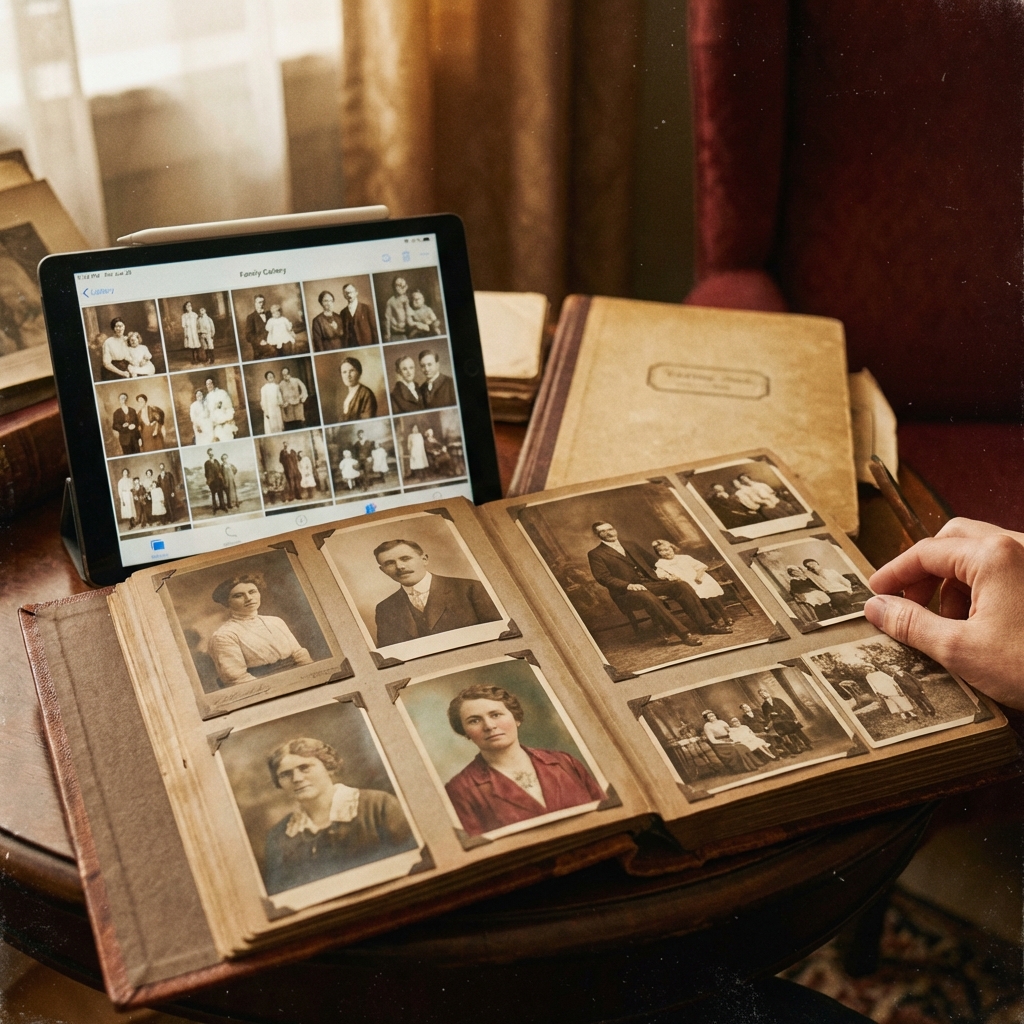
My grandmother kept her photos in the same faded album for sixty years. The cover was worn smooth from countless viewings, some pictures had yellowed with age, and a few had small tears or bent corners. But every single one was real.
I was flipping through it last week when something struck me: these imperfect, sometimes blurry, occasionally poorly-composed photos held more truth than the thousands of perfect images flooding my social media feeds every day.
The Authenticity of Imperfection
Look at old photographs from your family albums. What do you see?
People mid-blink. Red-eye from flash. Someone's thumb partially covering the lens. Awkward poses because the subjects didn't know exactly where to look. Shadows in weird places. Faded colors. Sometimes the focal length was off, making half the image blurry.
These weren't considered defects—they were just how photos turned out. Nobody expected perfection because achieving it required expensive equipment, professional lighting, and serious expertise.
Now compare that to photos from 2026. Every image seems professionally lit. Everyone's skin is flawless. Nobody's mid-blink. Backgrounds are artfully composed. Colors are vibrant and perfectly balanced.
Either we've all become expert photographers, or something else is going on.
What Changed (And Why It Matters)
The shift didn't happen suddenly. It crept up on us over the past decade, so gradually that most people didn't notice.
First came basic filters on Instagram—nothing sinister, just ways to adjust colors or add vintage effects. Then apps that smoothed skin or whitened teeth. Then programs that could remove blemishes entirely. Now we have AI that can generate entirely fake people who look more real than actual humans.
Each step seemed harmless on its own. But somewhere along the way, we crossed a line from "enhancement" to "fabrication."
My grandmother's generation trusted their eyes. If they saw a photo, they believed it documented something that really happened. Sure, they knew professional photographers could doctor images, but that required skill and effort. Regular people couldn't fake convincing photos.
That's not true anymore. Regular people—teenagers, your coworkers, your neighbors—can now create completely convincing fake images with minimal effort.
The Lost Art of Truth in Imperfection
Here's what those old photo albums taught me: imperfection is a feature, not a bug.
When you see someone mid-blink in a photo, you know it captured a real moment. When shadows fall awkwardly or the composition is off-center, you know the photographer was focused on the subject, not on creating a perfect image. When colors have faded or photos have bent corners, you have physical evidence of their age and handling.
These "flaws" are actually forms of authentication. They're proof that something real happened in front of a real camera.
Modern AI-generated images have no such proof. They can be absolutely perfect—and that perfection itself is often the giveaway.
I showed my grandmother some AI-generated "family photos" I found online. Know what she said? "These don't look real. They're too clean. Life isn't this clean."
She was right. Life isn't this clean. Real moments are messy, imperfect, unpolished. That messiness is what makes them genuine.
What We've Lost (And How to Find It Again)
I'm not suggesting we all throw away our smartphones and go back to disposable cameras. Technology isn't inherently bad, and modern photography has given us incredible capabilities.
But we've lost something important in our pursuit of perfection: the ability to distinguish between real and fake.
When everything looks perfect, nothing looks fake. We've normalized digital manipulation to such an extent that authenticity now looks wrong. A photo showing someone's actual skin texture gets criticized as "unflattering." A picture capturing genuine emotion gets dismissed as "not Instagram-worthy."
My grandmother's generation didn't have that problem. They valued truth over aesthetics. A photo's worth came from what it documented, not how polished it looked.
Lessons from the Pre-Digital Age
So what can we learn from those old photo albums?
Value imperfection. When you see a photo with obvious flaws—bad lighting, awkward poses, imperfect skin—that's often a sign it's authentic. Perfect images should make you suspicious, not envious.
Look for context clues. Old photos often included background details that helped establish their authenticity—specific locations, recognizable objects, dated clothing or hairstyles. Modern fakes often lack these contextual elements or get them wrong.
Check the physical reality. My grandmother's photos showed how light actually works, how shadows actually fall, how people actually look. AI systems sometimes create physically impossible scenarios that look fine at first glance but don't hold up to scrutiny.
Trust but verify. Our grandparents trusted photos because making convincing fakes required significant resources. We can't afford that luxury anymore. We need to verify before we trust.
The Paradox of Modern Photography
Here's the strange thing: we have better cameras than ever before. Our smartphones can capture images that would have amazed photographers from fifty years ago. We have more tools for editing, more ways to share, more ability to document our lives.
Yet somehow, we have less truthful photography than ever.
The technology isn't the problem—it's how we use it. And more importantly, it's what we've come to expect.
When I look at Grandma's photo album now, I see something valuable that we're losing: evidence. Each photo is evidence that something happened, that people existed, that moments occurred. They're not perfect, but they're true.
Moving Forward Without Looking Back
I'm not advocating we return to the past. I don't want to give up digital photography or smartphone cameras. But I think we need to reclaim some of that old appreciation for authentic, imperfect images.
Here's what I'm doing now:
Taking more "ugly" photos. Photos that capture real moments even if they're not aesthetically perfect. Photos that show people mid-laugh, mid-blink, mid-life.
Keeping originals. Before I edit anything, I save the original file. Because that unedited image has value as documentation, even if the edited version looks better.
Being honest about edits. If I significantly modify a photo, I say so. "Edited for lighting" or "AI-enhanced" gives people context they deserve.
Teaching younger family members. My niece is thirteen and has never seen an unedited photo of herself. I'm showing her Grandma's album so she understands that real people don't look like Instagram filters.
The Bottom Line
Grandma's photo album is far from perfect. The images are faded, sometimes damaged, occasionally poorly composed. But they're all real.
Every face in those photos existed. Every moment captured actually happened. Every smile, every awkward pose, every background detail—all real.
I can't say that about most photos I see online today. And that's a problem.
We're creating a world where perfection is commonplace but truth is rare. Where anyone can look flawless but nobody looks real. Where documentation is easy but credibility is hard.
Maybe it's time we started appreciating imperfection again. Not because old photos were better—they weren't. But because their flaws guaranteed their authenticity.
In a world of perfect fakes, maybe imperfection is the new luxury.
Explore More Insights
Discover more technical articles on AI detection and digital forensics.
View All Articles